Avoiding Snoozing with Active Learning
A Trip Down Memory Lane
Flashback to senior year, and you would find me asleep in my AP Art History class. Every day was a monotonous cycle of direct instruction. My teacher would read words verbatim off the PowerPoint slides. My classmates were passively taking in information, trying (or pretending) to take notes, and answering questions that regurgitated memorized information. Collaboration was rare. To sum it up, I was bored out of my mind. I was used to classes where I would create artwork, plan science experiments, participate in class discussions, and journal about different historical events. My other teachers used hands-on activities with some aspect of interactivity and engagement. Direct instruction has its time and place, but it would have helped if my AP Art History teacher added some spice in class.
Flash forward to today, and I am working in an elementary school. If my Generation Alpha students were ever in a class setting like the AP Art History class, I would not be surprised if I found them falling physically or mentally asleep. Like many teachers, I want my students to learn the facts, concepts, and skills I teach them. To do so, we need to use a strategies that gain students' attention, get some form of positive reaction, and engage them in their learning. That is where active learning comes in.
Active Learning and its Importance
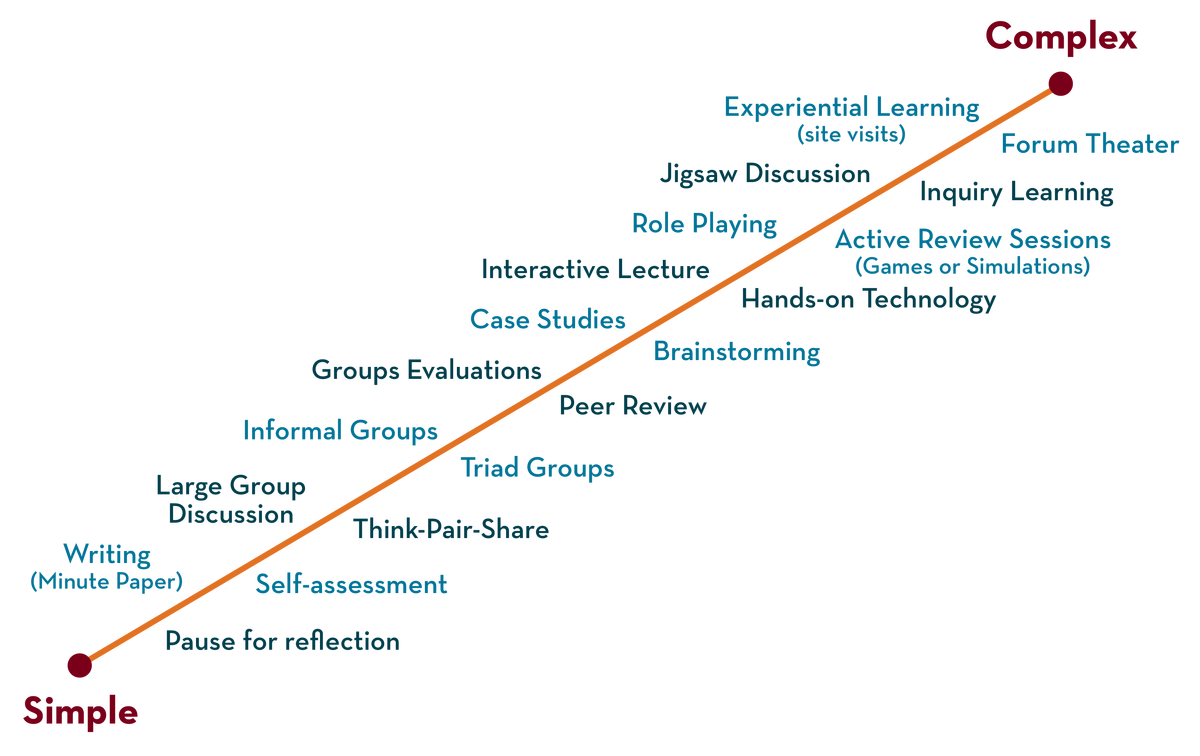
Active learning is a student-centered process that encourages students to take ownership of their learning journey. Teachers act as facilitators by giving students opportunities to engage with a topic by reading, writing, listening, discussing, evaluating, and reflecting. Students usually work together to solve problems and answer complex questions. In the image below, the University of MN: Center for Educational Innovation provides examples of simple to complex active learning strategies that teachers can use with their students.
 |
| Image Source: University of Minnesota's Center for Educational Innovation |
Teachers should keep active learning in mind when planning lessons. Giving students engaging activities to practice a skill and showcase learning helps them understand a topic more deeply, which increases retention. Teachers can also use active learning to build a sense of community by encouraging group collaboration and communication.
Active Learning in Action
Scenario 1: Self-Reflection and Critical Thinking with "A Year Told in Six Words"
If you prefer to learn about “A Year Told in Six Words” visually, check out my Padlet. I summarized the activity, explained how it is considered active learning, listed a few suggestions, and provided additional resources.
 |
| Image Source: Blog Author's Padlet |
I recently read a blog by Professor Zumpano, who challenged 1st-7th graders at Coonley School to sum up their school year in six words. She provided a list of questions to help with their reflection. The students created a Google Slide with those six summative words and a few images to represent them. Summarizing a whole school year into a limited amount of words is not an easy thing to do. Students must actively self-reflect on their experiences and use critical thinking skills to explain them. Each student considered what they learn, what they did, their strengths, challenges, and interests. Self-reflection requires a strong sense of awareness. Once they finish with self-reflection, they must apply written and visual communication in order to share their creations with the rest of the school community. This activity is student-centered and prioritizes their voices.
I like how students across a variety of grade levels could participate. If I were to add anything, I would provide more opportunities for differentiation. Students could have more options on how to showcase their six worlds. They could create a visual collage, a social media post, a voice recording, a video recording, and more. I would also do this activity multiple times a year. I want to see how their answers will change across the year and if specific classes had more impact on their experiences.
Scenario 2: Active Review Sessions with Breakout Boxes
At the moment, I am a library and technology assistant. Although I provide input and co-lead a few lessons, the lesson planning primarily falls on the library media specialist’s shoulder. Nevertheless, my experiences and observations help me increase the amount of ideas in my toolbox. One active learning activity that I would love to use in my future library is the breakout box challenges.
 |
| Image Source: BreakoutEDU |
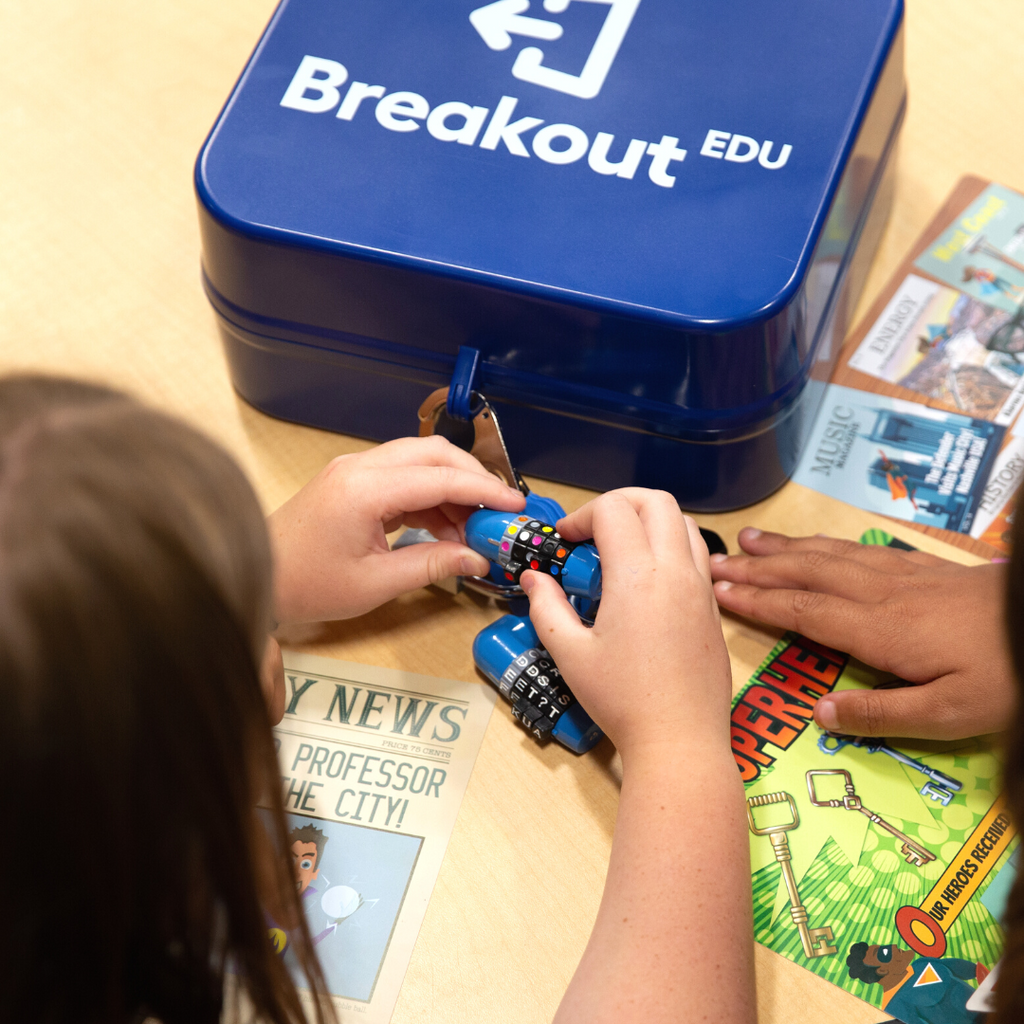
I first heard of a breakout box when I observed at Indian Trails Middle School Library with Aggie Farris. A breakout box is an escape room-inspired activity that can take many forms at any grade level. Farris creates breakout boxes for Math, Science, Language Arts, Social Studies, Spanish, and more. Some theme breakout boxes are one-step equations, the periodic table, the Declaration of Independence, Maps, Ancient Egypt, Spanish, and Alien Invasion. The breakout boxes are highly requested, and teachers use them to introduce a unit or reinforce content. This activity takes students one period to complete. Students work as a group and must communicate effectively to solve a combination of problems. They use clues placed throughout the room or within the locked boxes. These clues help them open different locks and discover the hidden content in the box. This activity is student-centered and helps make learning fun. It is engaging and interactive. It also helps students develop 21st-century skills. For example, students work on the 4Cs: collaboration, communication, critical thinking, and creativity. This is a team-based learning experience that requires collaboration and high order thinking skills. They also develop SEL (social-emotional learning) skills like self-awareness, self-management, social awareness, relationship skills, and responsible decision-making. Students can experience failure with this activity. However, the collaboration and encouragement from their team help them to persevere and try again. For more information on how the breakout box supports SEL and the 4Cs, check out this infographic from BreakoutEDU.
If you want to use a breakout box in your classroom but have no idea how to start, I would look at BreakoutEDU. The company offers a $199 breakout kit, a digital subscription, digital versions of the breakout boxes, and access to hundreds of lesson plans. The boxes provide all the materials needed to create a puzzle-based challenge, such as locks, a blacklight flashlight, a red lens viewer, a small USB drive, and invisible ink to create secret clues. If the kits are too expensive, librarians and teachers have created their own at an affordable price. Once Farris understood how breakout boxes worked, she made additional breakout boxes for less. She also customized the lesson plans to fit her learners’ needs. Overall, these breakout boxes help students access information in a fun, collaborative, and creative way. Teachers become facilitators of learning, while students are encouraged to take ownership of their learning.
Interested in more? Check out these resources:
- Watch students at Hilton Head Island Elementary School work on a Breakout Box Activity.
- Build Your Own Breakout Kits
- Create Digital Breakout or Escape Room in 5 Minutes
References
Active Learning. (n.d.). Cornell University’s Center for Teaching Innovation. Retrieved
September 19, 2023, from https://teaching.cornell.edu/teaching-resources/active-collaborative-learning/active-learning.
Active Learning. (n.d.). University of Minnesota’s Center for Educational Innovation. Retrieved
September 19, 2023, from https://cei.umn.edu/teaching-resources/active-learning.
Breakout. (n.d.). Breakout Edu - Educational Games. Breakout. https://www.breakoutedu.com/
Goerner, P. (2016, September 7). Breakout EDU Brings “Escape Room” Strategy to the
Classroom: SLJ Review. School Library Journal. https://www.slj.com/story/breakout-edu-brings-escape-room-strategy-to-the-classroom-slj-review..
Zumpano, N. (2015, June 17). One Year Told in Six Words. Blogspot.
http://zumpanotechlab.blogspot.com/2015/06/one-year-told-in-six-words.html.


You can create your own breakout boxes as well! This is such a fun way to engage students. I've done breakouts as low as kindergarten!
ReplyDeleteHello Jessa!
ReplyDeleteYour intro made me laugh at loud. AP Art History was also a popular time to nap at my high school for the same reasons: students were forced to sit in a dark lecture room immediately after lunch. This format definitely wouldn't work with Gen Alpha students, and I'm not so sure it was effective then either!
You provided some great resources on breakout boxes. I have not gotten to interact with these in person myself, and I am super interested in the subscription services, as well as the DIY resources. Breakout boxes seem to have the potential to keep material and challenges engaging and fresh, but I would like to learn more on how to maintain a sustainable collection or rotation in an educational setting. Thank you for sharing!